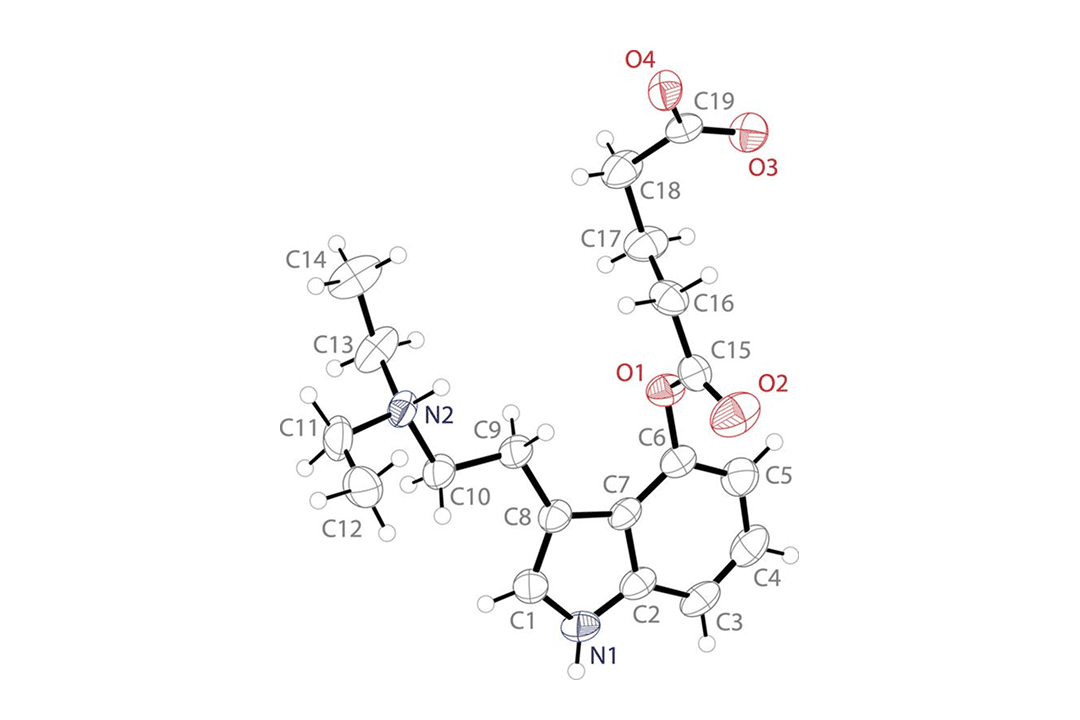
CaaMTech, in collaboration with the Manke Lab at the University of Massachusetts Dartmouth, has published a new peer-reviewed study reporting the first-ever synthesis and chemical characterization of 4-glutarato-N,N-diethyltryptamine (4-glutarato-DET). The paper, titled “4-glutarato-N,N-diethyltryptamine,” was published in the journal IUCrData. The study was co-authored by Marilyn Naeem, Ph.D., Andrew R. Chadeayne, Ph.D., James A. Golen, Ph.D., and Professor David R. Manke, representing a continuation of their productive scientific partnership crystallographically characterizing next-generation serotonergic compounds.
The novel compound, 4-glutarato-DET, is designed as a prodrug of 4-hydroxy-N,N-diethyltryptamine (4-HO-DET, also known as ethocin), a psychoactive tryptamine that has recently surged in prevalence the retail “magic mushroom” marketplace. CaaMTech, in collaboration with the Manke Lab and Tryptomics, LLC, recently published crystal structures of 4-HO-DET and its prodrug 4-AcO-DET. CaaMTech has also previously synthesized glutarate prodrugs of other tryptamines and published their crystal structures, such as the methanol and ethanol solvates of 4-glutarato-diisopropyltryptamine (4-glutarato-DiPT). The work both advances CaaMTech’s tryptamine prodrugs program, and provides new reference data for the identification of 4-glutarato-DET in emerging consumer products.
While standard analytical laboratories can readily identify 4-HO-DET and its common acetoxy prodrug, 4-AcO-DET, because commercial reference standards exist, detecting more complex, “designer” prodrugs like 4-glutarato-DET is exceptionally difficult without reference data. This work directly addresses a growing public safety need, as establishing rigorous standards helps prevent mischaracterization as synthetic tryptamines continue to emerge in unregulated consumer products.
This research advances CaaMTech’s broader tryptamine prodrug program, which aims to understand and optimize how classic psychedelics are delivered and metabolized by the body. A 2024 study by Bryson et al published in the journal ACS Chemical Neuroscience proved that the 4-glutarato group of 4-glutarato-DiPT undergoes complete metabolic conversion to its active 4-hydroxy counterpart (4-HO-DiPT) in human plasma. Glutarates function as reliable, plasma-validated delivery vehicles, and this work expands CaaMTech’s library of glutarate prodrugs to the diethyl family with 4-glutarato-DET. This addition provides the essential structural data needed to help design next-generation psychiatric treatments with highly predictable and tailored pharmacokinetic profiles, onset times, and durations.