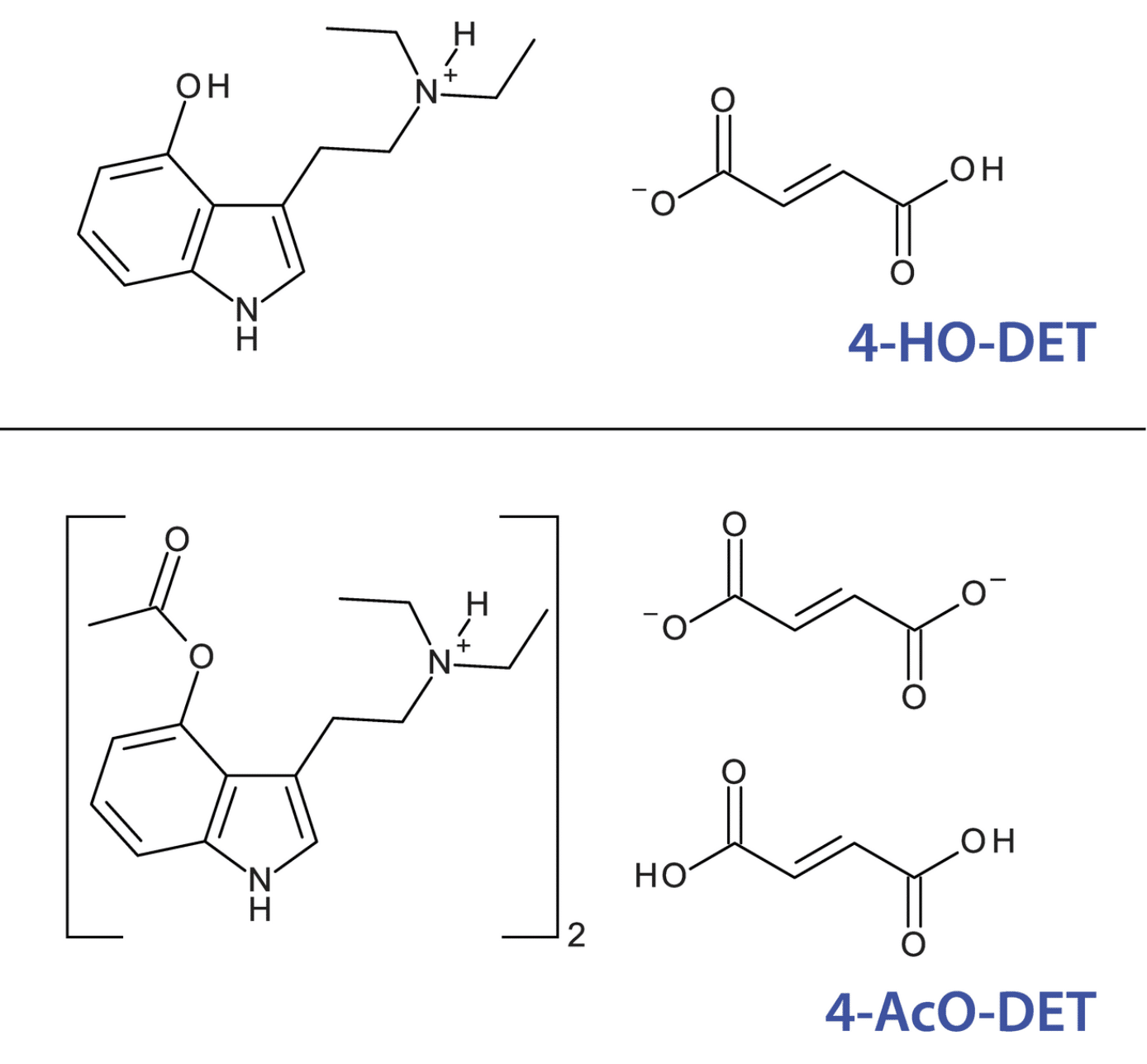
CaaMTech, in collaboration with the Manke Lab at the University of Massachusetts Dartmouth and Tryptomics, LLC, has published the first single crystal X-ray diffraction structures of two trending diethyl tryptamines: 4-hydroxy-N,N-diethyltryptamine (4-HO-DET, also known as ethocin) and its synthetic prodrug, 4-acetoxy-N,N-diethyltryptamine (4-AcO-DET). Published in the journal Acta Crystallographica Section E, the study titled “Crystal structures of New Psychoactive Substances 4-HO-DET and 4-AcO-DET” provides definitive physical characterizations of these two molecules, which have recently exploded in prevalence in consumer products.
Both 4-HO-DET and 4-AcO-DET have histories dating back to the mid twentieth century: Albert Hofmann first reported the synthesis of 4-HO-DET in 1959, and later synthesized the prodrug 4-AcO-DET with Franz Troxler in 1963. In 1989, researcher Jochem Gartz famously demonstrated that Psilocybe mushrooms could produce these diethyl derivatives when their mycelium was introduced to N,N-diethyltryptamine. Pharmacologically, 4-HO-DET is a potent agonist of the serotonin 2A receptor and is highly psychoactive. 4-AcO-DET does not itself bind directly to this receptor, but hydrolyzes in vivo to produce 4-HO-DET and displays similar psychoactivity in animal studies.
Defining the physical properties of these compounds is particularly crucial given their recent surge in the retail marketplace. A 2025 study by van Breeman and collaborators published in JAMA Network Open revealed that retail edibles sold as “magic mushrooms” often contain no psilocybin at all, instead utilizing synthetic tryptamines. “Magic mushroom” edibles and inhalables are now commonly sold in the United States both online and in physical retailers, including vape shops and convenience stores. Synthetic tryptamines are rarely disclosed in these products, whether on product packaging, in marketing materials, or in brand-supplied third-party lab results. Instead, psychoactive ingredients are typically specified generically, using terms such as “proprietary nootropic blend” while mushroom ingredients are limited to non-psychoactive fungi such as cordyceps, and reishi and chaga mushrooms.
As a part of the research, co-authors Christopher Pauli and Caleb King of Tryptomics, LLC, anonymously analyzed commercial samples using high performance liquid chromatography. They identified 4-AcO-DET or 4-HO-DET in 87 samples. CaaMTech is unaware of any products that advertise the presence of 4-AcO-DET or 4-HO-DET, despite surveying product packaging, marketing materials, and brand-supplied third-party lab results for hundreds of similar “magic mushroom” products available in the US market. Products that do not disclose or inaccurately represent their psychoactive ingredients or doses present unnecessary risks and inhibit safe and responsible use.
“As these new psychoactive substances become increasingly prevalent, establishing rigorous chemical reference standards is essential for consumer safety and scientific accuracy,” commented Dr. Andrew Chadeayne, CaaMTech CEO. “Everyone, including scientists, regulators, consumers, and doctors would benefit from an accurate understanding of the active molecules and the amount contained in these products. This is one thing we should all agree on.”